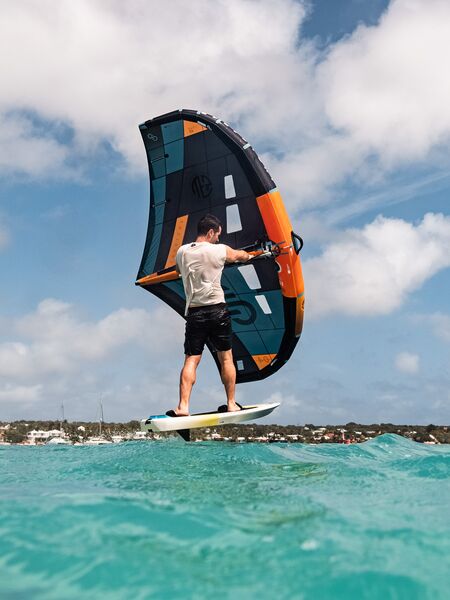
Wingfoil (or wing foiling) is the most innovative water sport of recent years. It combines a portable inflatable wing held in the hands with a board equipped with a hydrofoil — an underwater appendage that lifts the board out of the water, making you literally fly above the surface.
Born around 2019, wingfoil has seen explosive growth, winning over both water sports veterans and newcomers attracted by its accessibility and the unique sensation it delivers.
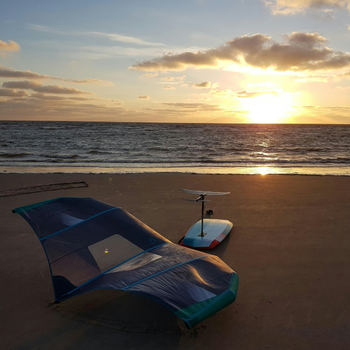
The concept is elegant in its simplicity: you hold in your hands a light inflatable wing that catches the wind and generates traction. Under your feet you have a board with a foil — an underwater wing made of carbon or aluminium mounted on a vertical mast.
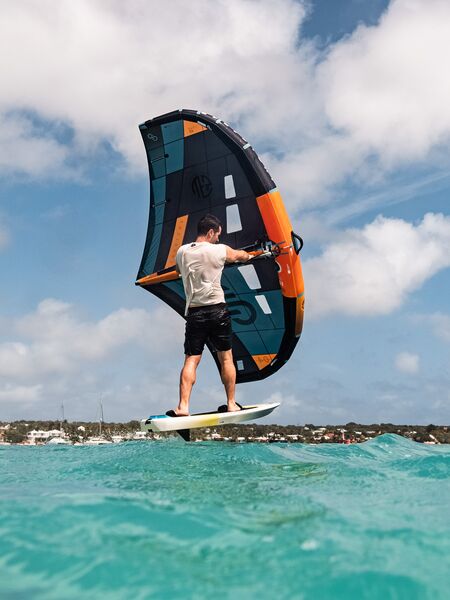
When you reach sufficient speed, the foil generates lift (the same principle that makes aeroplanes fly) and the board rises out of the water. You then glide at around 30–60 cm above the surface, in an almost total silence, with an incredible sensation of flight.
The inflatable wing is the heart of the sport. It is held with both hands via a central handle or side handles. Sizes range from 3 to 7 square metres, depending on the wind and the rider's weight. Unlike a kite, the wing is not attached to the body: you can let it go at any moment for maximum safety.
The board is shorter and wider than a traditional surfboard (typically 70–130 litres). Underneath is mounted the hydrofoil, composed of:
A leash at the ankle or waist connects the rider to the board, and a second leash at the wrist or waist is used for the wing. A wetsuit, helmet and impact vest complete the equipment for the first sessions.
Ease of learning — Compared to kitesurfing, wingfoil has a gentler learning curve. There are no lines to manage, no need to launch and land a kite. You can start with a large, stable board without a foil, and progress gradually.
Minimal bulk — All the equipment fits in the boot of a car or in a travel bag. No pumps, no lines to lay out on the beach. You arrive, inflate the wing in 2 minutes, and you are in the water.
Works with little wind — Thanks to the efficiency of the foil, you can ride with as little as 12–14 knots of wind, conditions in which a kiter would stay ashore. This means more days on the water during the year.
The sensation — Those who try foiling for the first time always describe it the same way: "It's like flying". The silence, the fluidity, the lightness — it is an almost meditative experience, completely different from any other water sport.
Safety — Without lines and without being attached to anything, wingfoil is inherently safer. In the event of a problem, simply let go of the wing and the board stops.
It is not a question of "better" or "worse" — they are complementary experiences:
Kitesurfing excels for those seeking adrenaline, huge jumps and power. Wingfoil is perfect for those who love the sensation of flight, freedom and the possibility of going out in any wind conditions.
Many riders practise both: kite when the wind is strong, wing when it is light. The perfect combination for never being stuck on land!
The recommended path for a beginner:
With a structured course of 3–5 days, most people manage to achieve their first flights on the foil.
Wingfoil is waiting for you! Discover our wingfoil courses with Blue Tribe.
 Italiano
 English
 Deutsch
 Español
 Français