 Italiano
 English
 Deutsch
 Español
 Français
Kitesurfing and Wingfoil: Benefits for Mind and Body
That feeling you never forget
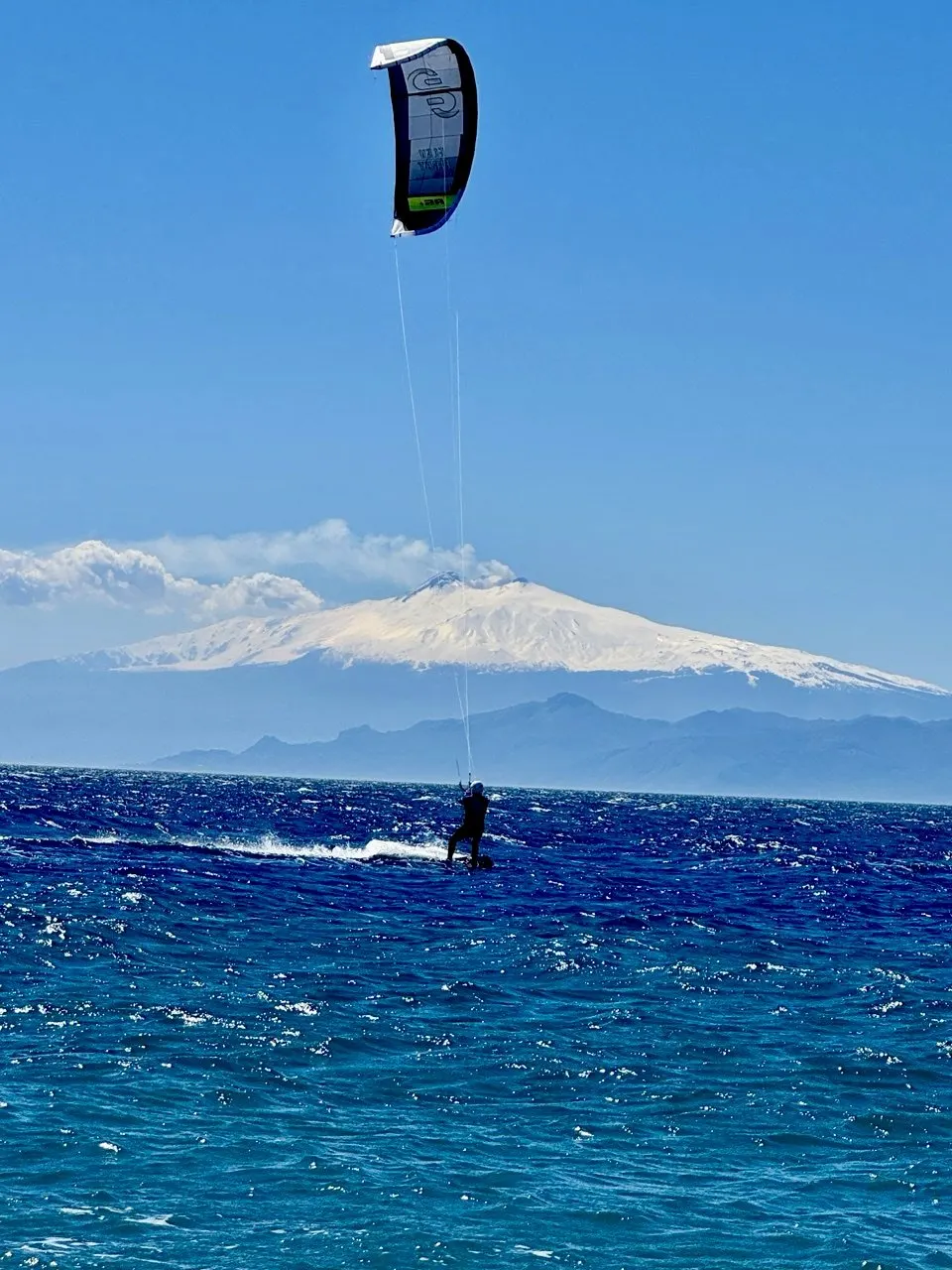
There is a moment — precise, unrepeatable — that every kiter and foiler knows. It is not the first time you stand up on the board, nor when you complete your first run. It is the moment when you stop thinking. When your body knows exactly what to do, the wind becomes part of you and the water is no longer an obstacle but a stage. It is the moment when you are — simply — free.
That moment has a name in modern psychology: the flow state. And once you know it, nothing is ever quite the same again.
The Flow State: when time stands still
The concept of flow was theorised by psychologist Mihaly Csikszentmihalyi to describe a state of total, conscious immersion in an activity — when challenge and skill meet perfectly and the result is pure pleasure, free of conscious effort.
Kitesurfing and wingfoil are among the most effective disciplines in the world for inducing this state. Why? Because they demand everything. Attention to wind direction, body posture, wave reading, bar or wing control, instant adaptation to conditions. There is no room to think about work problems, daily worries or your phone. The only moment that exists is the present one. And in that space — between sky, water and wind — the mind breathes.
The brain in water: the neuroscience of happiness
It is not just emotion. It is chemistry. When you practise kitesurfing or wingfoil, your brain releases a cocktail of neurohormones that produce deep, lasting effects on your mood and mental health:
Dopamine — the molecule of motivation and reward. Every successful trick, every jump, every perfect glide generates a dopamine spike that the brain learns to seek. This is the same mechanism that makes passionate people tireless.
Serotonin — the neurotransmitter of deep well-being. Contact with nature, sunlight, physical movement and the feeling of competence continuously feed serotonin levels. Regular kiters sleep better, feel calmer and manage stress more effectively.
Endorphins — the body's natural painkillers. Produced during intense physical effort, they create that post-session euphoria kiters simply call the "post-kite glow": a state of euphoric relaxation that can last for hours.
Adrenaline — the molecule of courage. Managing the wind, facing waves, executing manoeuvres at the edge of your abilities trains the nervous system to handle excitement without being overwhelmed by it. In everyday life, this translates into greater resilience to stress and a more calibrated fear threshold.
Pushing your limits: the transformation you don't expect
Nobody learns to kitesurf without falling. Nobody flies on a foil without swallowing litres of water in the first sessions. And it is precisely in those falls that something extraordinary happens: you learn that failure is not the end. It is the beginning.
Every session is a process of real-time problem-solving. Why is the kite stalling? How to correct posture on the foil? How to handle an unexpected gust? The brain, faced with these continuous challenges, develops neuroplasticity — the ability to create new neural connections, to adapt, to grow. It is literally a workout for the mind.
The result? Solid self-esteem, built on real experience. Not on empty compliments, but on goals achieved through effort, patience and determination. The self-confidence born on the water transfers into life: in difficult decisions, professional challenges, relationships. Those who kite are changed at a deep level.
Mindfulness without meditation: total presence
You don't need to sit on a cushion to be mindful. Sometimes all it takes is a kite above your head. Kitesurfing and wingfoil impose a total presence in the current moment that no meditation app can replicate. When you're on the water, the only reality that exists is this: the wind, the board, your body, the water beneath your feet.
This repeated practice — session after session — rewires the brain circuits linked to attention and awareness. Studies on the therapeutic effects of water sports show significant reductions in anxiety, depression and intrusive thoughts in regular practitioners. The sea does not judge. The wind does not wait. And in that absolute simplicity, the mind heals.
A complete workout that doesn't feel like a workout
The body is no exception. Kitesurfing and wingfoil are two of the most complete functional workouts in existence:
Core — the continuous stabilisation work on the foil or board deeply activates the core muscles: transversus abdominis, multifidus, obliques. Not like a set of crunches, but as a constant, natural, instinctive engagement.
Muscular strength and endurance — shoulders, lats, arms, legs: everything works. Wingfoil in particular is considered more demanding than kitesurfing at a muscular and aerobic level, especially during the start phase and pumping to gain altitude.
Cardio and calorie burning — one hour of kitesurfing burns between 500 and 700 calories. Wingfoil burns between 400 and 700. But unlike running on a treadmill, you don't notice: you're flying.
Balance, coordination and proprioception — the continuous adaptation to the moving water surface develops an exceptional sense of balance, with positive effects on posture, agility and injury prevention in daily life.
Flexibility and elasticity — bar management, torso rotations, knee bends maintain joint and muscle mobility, counteracting the sedentary effects of modern life.
Becoming one with the elements
There is a dimension of kitesurfing and wingfoil that goes beyond science, beyond muscles and neurons. It is that feeling of merging with nature that you experience when everything works: when the wind pushes, the board glides, the foil lifts you and your body is in perfect balance between sky and sea.
In that moment you are no longer an athlete practising a sport. You are part of the system. You are wind, water, movement. It is a feeling that people who have experienced it describe as one of the most beautiful of their lives. An experience that reminds the modern human being — always connected, always rushing — that existing in your own body, in the present, in nature, is the highest form of wellbeing.
The trick: why landing a manoeuvre changes everything
Have you ever worked for weeks on a manoeuvre — a raley, a back roll, a foil gybe — and then, one day, suddenly: it works? That moment is one of the most powerful an athlete can live. Not because the trick itself matters. But because it proves something fundamental: you can learn anything if you believe in it, work at it and don't give up.
Every trick is a metaphor for life. It requires visualisation, repeated practice, management of frustration, perseverance and — in the end — the courage to really try. People who practise kitesurfing and wingfoil develop a growth mindset that applies naturally to every challenge they encounter off the water.
The tribe: because you never grow alone
There is one last thing that kitesurfing and wingfoil give you that no list of benefits can truly capture: community. The tribe of people who share your same passion, the same glance toward the wind, the same childlike joy every time the conditions are perfect.
In this community you share knowledge, sessions, laughter, epic falls and achievements. You push each other to improve. You support each other when frustration arrives. And you celebrate every small, great result together. Because the most beautiful sport in the world is even more beautiful when lived together.
This is Blue Tribe. Not just a school. A family that flies, falls and rises again — together. If you have not yet lived this experience, come and find us at Punta Pellaro, on the Strait of Messina. The wind is waiting for you.
info@bluetribe.surf | +39 392 776 7500 | www.bluetribe.surf