There is something deeply human about the desire to be carried by the wind. Not as one who surrenders, but as one who dances. Kitesurfing — with its board, its lines and that enormous colourful kite slicing through the sky — embodies this dance better than any other sport. But to understand where we are today, we need to go back. A long way back.
The story begins in China, around 1200 AD, when fishermen in the Fujian region started using rudimentary kites to pull their boats upwind. It was not sport. It was survival. It was ingenuity. It was, perhaps, the first moment a human being understood that wind could become a powerful ally — if only you knew how to speak its language.
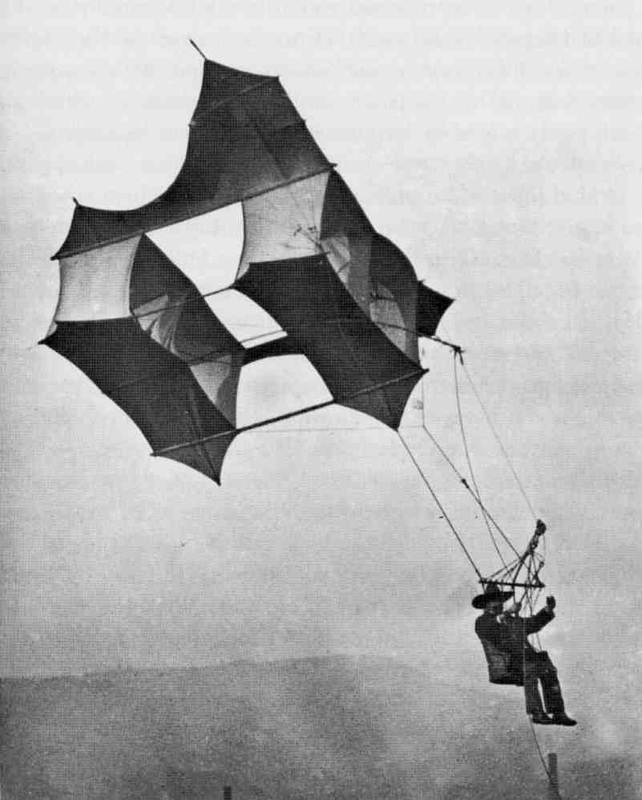
Centuries later, in Europe, the idea knocked on history's door again. In 1826, English inventor George Pocock patented a kite system — which he called the Charvolant — capable of pulling carriages and boats. He demonstrated that aerial force could move considerable loads, challenging the orthodoxy of steam that was conquering the world. Nobody paid enough attention. The world was not yet ready.
The quantum leap came in 1977, when young American engineer Gijsbrecht Panhuise filed a patent for a system in which a person on a board was pulled by a parabolic kite. It was primitive, almost bizarre. But it was the first time anyone had imagined exactly what we today call kitesurfing.
The world waited a few more years. Then came the Legaignoux brothers.
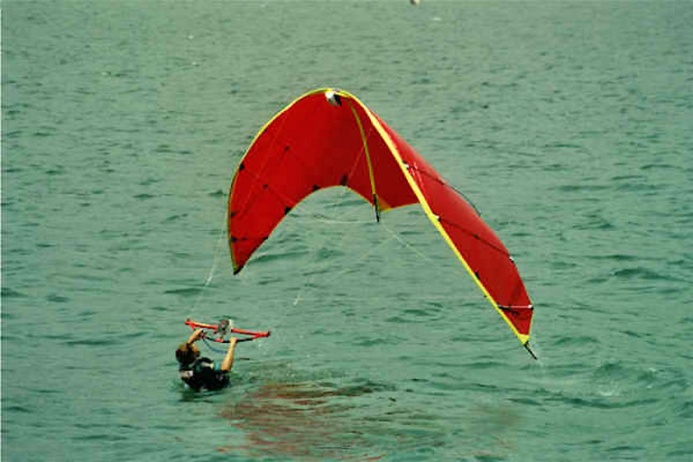
It was 1984. On the Breton coast of France, two brothers passionate about sailing and wind were searching for something different. Something nobody had yet found. After years of attempts, failures and rethinking, they patented the first inflatable kite — what we now call a tube kite or LEI (Leading Edge Inflatable). It was an epochal breakthrough: a kite that could be relaunched from the water, that did not sink, that could be controlled. A kite that forgave mistakes.
The Legaignoux brothers tried to commercialise it. The timing, once again, was not right. They sold the licence for a pittance. But they had already changed everything.
The scene shifts to Hawaii, the cradle of every wind and wave discipline. It was here, at the end of the 1980s and into the 1990s, that pioneers began experimenting systematically. Among them stood Laird Hamilton, already a surfing legend, who in 1996 — together with Manu Bertin, Robby Naish and others — filmed a kitesurfing session in Maui that went around the world.
But the name history remembers as the father of modern kitesurfing is Cory Roeseler, who from 1994 was organising the first informal water races with kite and board. And then there was Raphaël Salles, who in 1997 opened the first real kitesurfing school in the world in France, training the first instructors.
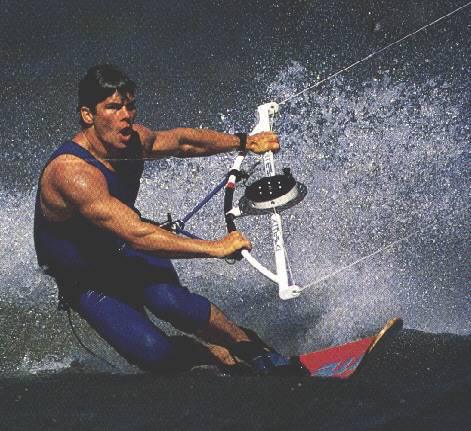
1998 was the year of commercial breakthrough: the first schools, the first kits for sale, the first videos circulating on worn-out VHS tapes. Anyone who saw those images — a person being pulled at wild speed across the water, then launching into the air as if gravity were a mere suggestion — knew they were watching something new. Something they wanted to try.
The new millennium brought an unprecedented explosion. Boards improved, kites became safer, quick-release systems reduced risks. The IKA (International Kiteboarding Association) began organising the first world championships.
Kitesurfing stopped being a subculture of diehards and became a global sport. From Caribbean coasts to Egyptian lagoons, from Brazilian beach breaks to Greek islands, wherever there was wind and water, schools, communities and competitions sprang up. Beaches filled with colour. The sky came alive with kites.
This era also produced the first great names of the sport: Gisela Pulido — world champion for 10 consecutive years from 2004, at just 12 years old — Aaron Hadlow, Kevin Langeree, Karolina Winkowska. Names that would become legends.
It seemed impossible to make kitesurfing even more spectacular. Then came the kitefoil.
The hydrofoil — a structure that lifts the board completely out of the water through hydrodynamic lift — was already known in sailing. But applying it to kitesurfing changed everything. Suddenly riders were literally flying above the water, at speeds exceeding 50 knots, in near-total silence. Contact with the water's surface was reduced to a minimum. The feeling of freedom became absolute.
In 2012, Alexandre Caizergues set the kitesurfing world speed record at 54.10 knots (over 100 km/h), surpassing every other sailing vessel. Kitesurfing had become the fastest sail-powered sport on flat water in the world.
It was inevitable. A sport so spectacular, so technical, so capable of attracting audiences and media could not stay out of the Olympic Games forever.
World Sailing included kitefoil in the Olympic programme after a long evaluation process. The official decision came: kitesurfing would be an Olympic discipline at Paris 2024.
It was news that many pioneers could not have dared imagine twenty years earlier. Those kids on Hawaiian beaches, with their hand-stitched kites and modified windsurfing boards — were they looking towards the Olympics?
Probably not. They were looking at the wind.
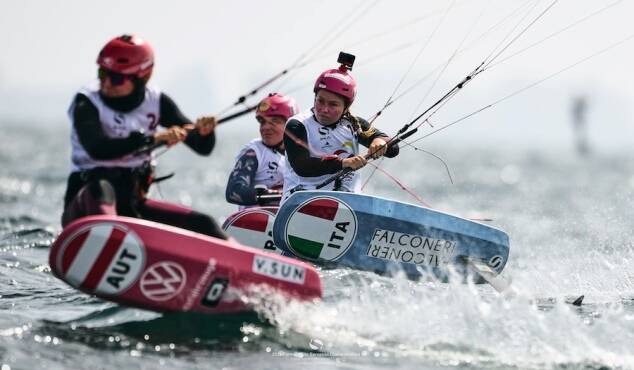
On 6 August 2024, in the bay of Marseille, under a sky that seemed made for the occasion, the world's best kitefoilers competed for the first Olympic medal in kitesurfing history.
The Formula Kite races — both men's and women's — were an unforgettable spectacle. Athletes flew over the water at incredible speeds, executing pinpoint tacks, harnessing every breath of wind with superhuman precision.
They were there. From the wind of a Chinese kite in 1200, to the Breton sprays of 1984, to the Maui beaches of the 1990s, to the Mediterranean waters of Marseille. Eight hundred years of history. One single thread: the wind.
Kitesurfing is today one of the fastest-growing water sports in the world. Millions of practitioners, hundreds of schools, dozens of different disciplines — freestyle, wave, speed, foil, snow kite, land kite — and a global community united by that same primordial feeling: wind on your face, board underfoot, knowing you are flying.
Here at Blue Tribe, on these Mediterranean waters tasting of salt and adventure, we carry that story forward every day. Every student who launches their kite for the first time is a new chapter in this never-ending story.
The wind never runs out. And neither does the dream.
"Kitesurfing is not a sport. It is a conversation with the wind."
 Italiano
 English
 Deutsch
 Español
 Français