 Italiano
 English
 Deutsch
 Español
 Français
What Is Kitesurfing: How It Works and How to Learn
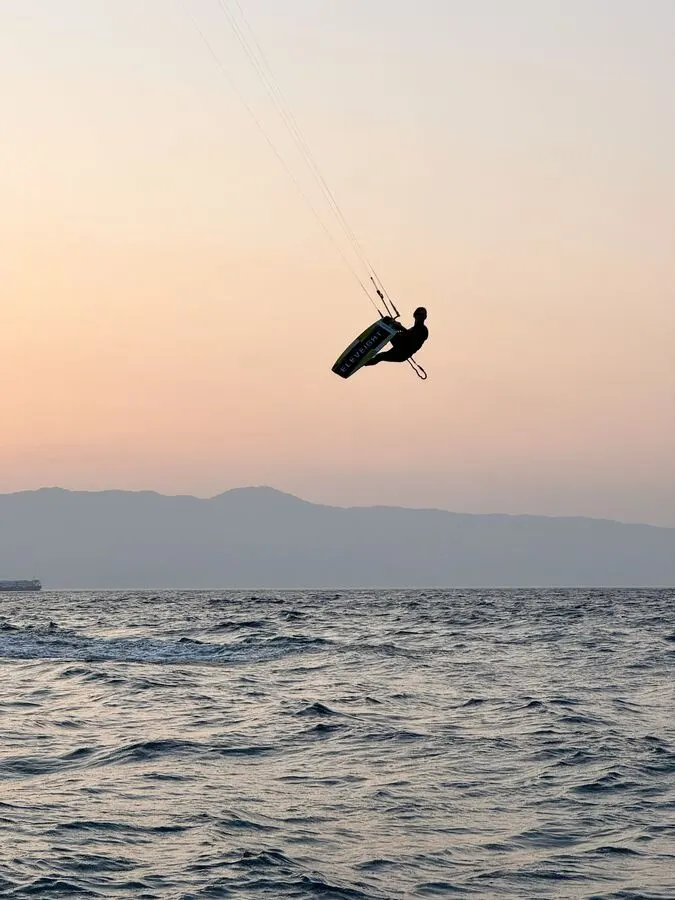
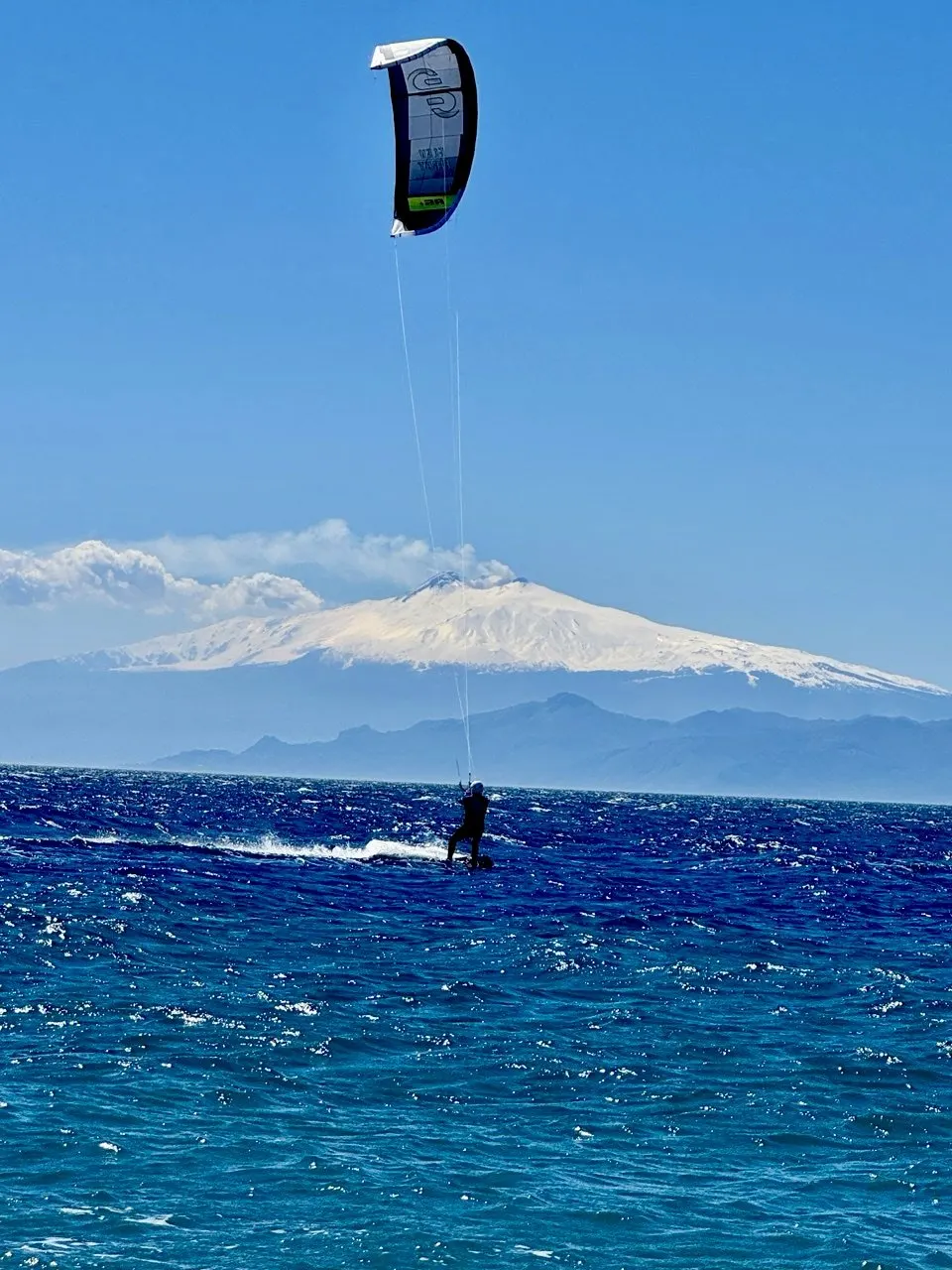
There's one precise moment when everything changes. The kite stops being a weight that pulls and becomes an extension of your own body. The board, which a second earlier kept slipping out from under your feet, suddenly grips the water. And all at once you're no longer fighting: you're planing. The noise of the world switches off, and all that's left is the rush of water flowing beneath you and the wind at your back. Those who feel it for the first time at Punta Pellaro, facing the Strait of Messina, always describe it with the same words: "I'll never be the same again."
But let's take it one step at a time. If you're here, you're probably wondering what kitesurfing really is, how it works, and why so many people — from teenagers to fifty-somethings chasing a second life — become so captivated that they organise their entire days around the wind. This isn't your usual guide. It's the full story: the physics, the technique, the safety and, above all, the part nobody tells you about — the emotions.
What is kitesurfing: the real definition
Kitesurfing (or kiteboarding) is the watersport in which a person glides across the water on a board, towed by the power of the wind channelled through a large inflatable kite — the kite itself. That single sentence already captures its magic: you take the invisible energy of the air and turn it into motion, speed and, whenever you like, flight.
Born in the 1990s from the meeting of several disciplines — surfing, windsurf, wakeboard and kite flying — it became an Olympic sport within thirty years (it made its debut at Paris 2024 in the formula kite class). But reducing it to its technique would be like describing a sunset by listing the wavelengths of light. Kitesurfing is, first and foremost, a relationship with the wind.
You don't control the wind. You learn to have a conversation with it. And in that conversation you discover something about yourself, too.
How kitesurfing works: the wind window
Here lies the technical heart of it, the concept that separates those who "get it" from those still wondering how it's even possible to ride upwind. It's called the wind window, and it's the key to everything.
Picture yourself standing with your back to the wind, a giant imaginary dome in front of you, as wide as the length of the lines that connect you to the kite (usually 20–24 metres). That dome is the space in which your kite can fly. And it isn't uniform: it's divided into zones of different power.
- The neutral zone (the edge of the window): this is the highest band and the sides, like the "12 o'clock", "9 o'clock" and "3 o'clock" positions on a clock face. Here the kite generates almost no power: it's the resting position, the one you use to launch, land and walk safely.
- The power zone (the lower centre): when you bring the kite down from the centre toward the bottom — from "12 o'clock" toward "10 o'clock" or "2 o'clock" — you cross the zone where the kite offers its maximum surface to the wind. This is the power stroke: the burst of power that lifts you and sets you moving.
Flying the kite means exactly this: moving it precisely within the window to meter the power. A small movement of the bar translates into a huge pull or a moment of calm. And the secret to riding upwind? The board: by setting it "on edge" against the water (the edging), you convert the kite's sideways pull into forward drive — exactly like a sailing boat beating to windward. Pure physics, which after a few lessons becomes instinct.
Kitesurfing gear, without the pointless jargon
Plenty of guides bury you in acronyms. You only need to understand five things:
- The kite: an inflatable wing ranging from 5 to 17 square metres. Golden rule: the more wind there is, the smaller the kite. In light wind you use a big wing, in strong wind a small one. That's why riders often own several sizes.
- The bar and the lines: the control bar you hold in your hands, connected to the kite by four lines. You pull the bar toward you to add power, push it away to take it off (the so-called depower). Simple, immediate, vital.
- The harness: the belt you wear around your waist. It's the harness — not your arms — that takes the kite's pull. That's exactly why kitesurfing isn't about physical strength: it's practised by teenage boys, girls and adults of every build.
- The board: to start out you use a twin tip, similar to a wakeboard, symmetrical and forgiving, which rides in both directions without having to turn it around.
- The safety systems: the chicken loop with its quick release and the leash. In a single second you can completely "switch off" the kite's power. Knowing how to use these systems is the first, true lesson — and the reason why kitesurfing, learned properly, is far safer than it looks.
The ideal conditions? A wind between 12 and 25 knots, preferably onshore or cross-onshore (blowing toward the shore or across it), the safest because it always carries you back toward land. And this is where the Strait of Messina becomes pure magic: its steady thermal breezes make it one of the most reliable spots in the Mediterranean. We cover it in detail in our guide to the best spots in Calabria.
How long does it take to learn kitesurfing?
The most frequent question, and the most honest answer: 8 lessons on average with a certified instructor to reach basic independence, meaning you can restart from the water and ride safely. From there on, it's all progression and fun.
The path — the one we follow according to the international IKO standard — is gradual and has a clear logic:
- On land: wind theory, safety, flying the kite with a small trainer kite. You learn to "feel" the wind window without any risk.
- The body drag: in the water, without the board, you let the kite tow you to build confidence with the power and learn how to recover your board.
- The water start: the moment everyone waits for — you put your feet on the board, give the power stroke and… off you go. You never forget your first glide.
A piece of advice from someone who teaches it every day: don't improvise and don't learn "from friends". A badly handled kite is dangerous for you and for others; learned at a serious school, with qualified instructors and safety equipment, it's one of the most rewarding and controllable sports there is. We've written about why lessons truly make the difference.
What does it feel like? The secret is the state of flow
Now for the part the technical guides forget. Why does kitesurfing become addictive (in the best possible way)?
The answer has a name psychologists know well: flow, the flow state. It's that mental condition in which you're so immersed in what you're doing that time dissolves, your thoughts fall silent and you stay completely in the present. In kitesurfing it happens naturally and inevitably: you have to keep an eye on the kite, feel the board, read the gusts, correct your course. There's no room for yesterday's anxiety or tomorrow's deadlines. There's only now.
Your body, meanwhile, thanks you for it: it releases endorphins, dopamine, serotonin — the feel-good hormones. It's no coincidence that kitesurfing is increasingly used as therapy with the wind against stress, anxiety and depression. Out on the water there are no notifications, no emails, no phones. There's you, the wind and your kite. It's the most genuine detox there is.
You climb onto the board to do sport. You come back with an empty head and a full heart. That's what brings you back, every single time.
Why kitesurfing changes your life (and slows it down)
And here we come to the most beautiful paradox of this sport. Kitesurfing is speed, adrenaline, jumps — and yet those who practise it almost always end up discovering a slower, deeper life.
The reason is simple: when your happiness depends on the wind, you change the way you look at the world. You learn to check the weather forecast with the same care you once gave your notifications. You learn to wait, because the wind can't be commanded. You learn to seize the moment — when it blows, you drop everything and go. And you learn the value of a community: on the beach there are no roles, no hierarchies, only the tribe of those who share the same passion, help each other launch, and cheer for a beginner's first glide.
For many it's the start of a bigger change: letting go of what wasn't making them happy, travelling in step with the seasons of the wind, rediscovering silence and nature. It's no accident that those who enter this world speak of "before" and "after". The wind has that power: it reminds you that you're alive. If you'd like to dig deeper, we've dedicated a whole article to how this sport transforms mind, body and life.
Frequently asked questions about kitesurfing
Is kitesurfing dangerous?
Learned at a certified school, with equipment fitted with a quick release and in respect of the weather conditions, kitesurfing is a safe sport. The risks almost always come from improvising: setting off without training, in the wrong wind or with gear that hasn't been serviced. That's why the first step is always a course with qualified instructors.
Do you need to be fit or have strong arms?
No. The kite's pull is held by the harness, not by your arms. It takes balance, coordination and sensitivity more than brute strength. It's a sport suited to men and women of every age and build.
Do I need to know how to swim?
Yes, being able to swim and feeling at ease in the water is the fundamental requirement. During lessons you always wear a buoyancy vest and a helmet.
What age do you need to be to start?
You generally start from 12–14 years old (with enough weight to handle the wing) and there's no upper limit: among our students are adults who took it up well past their fifties.
What's the difference between kitesurfing and wingfoil?
In kitesurfing the wing flies in the sky, connected to you by lines; in wingfoil you hold a rigid wing in your hands and "fly" above the water thanks to a board with a foil. They're cousins, with different sensations. We talk about it in our guide to wingfoil.
Come and discover what kitesurfing is. At Blue Tribe.
You can keep reading about kitesurfing — or you can feel it. At Blue Tribe, our kitesurf and wingfoil school at Punta Pellaro, Reggio Calabria, facing one of the windiest and most spectacular stretches of water in the Mediterranean, we put the bar in your hands for the very first time with IKO and CONI instructors, in complete safety.
You don't need experience. You don't need gear. All you need is the desire to feel that instant when you start to plane — and to understand, in your own skin, why you'll never be the same again.
👉 Discover the courses and book your first kitesurfing lesson — or become a Blue Tribe member and join the tribe. The wind is already blowing. We'll be waiting for you at Punta Pellaro. 🌊
Gallery